


Your paid ads generated 200 leads this month. Cost per lead dropped. Marketing looks busy.
Then sales opens the CRM: students, companies outside your market, people who wanted the free download, and a few prospects nobody has contacted yet.
How good were those 200 leads? The advertising dashboard can’t answer that on its own.
The MQL vs SQL distinction gives you a way to separate marketing-qualified prospects from people sales has actually qualified. Used properly, those stages help you decide which campaigns deserve more budget. Used loosely, they give everyone another number to argue about.
As a performance marketer who has managed 7-figure budgets, here’s how I’d define MQLs, SQLs, and measure B2B paid ads lead quality.
MQL vs SQL: What’s the Difference?
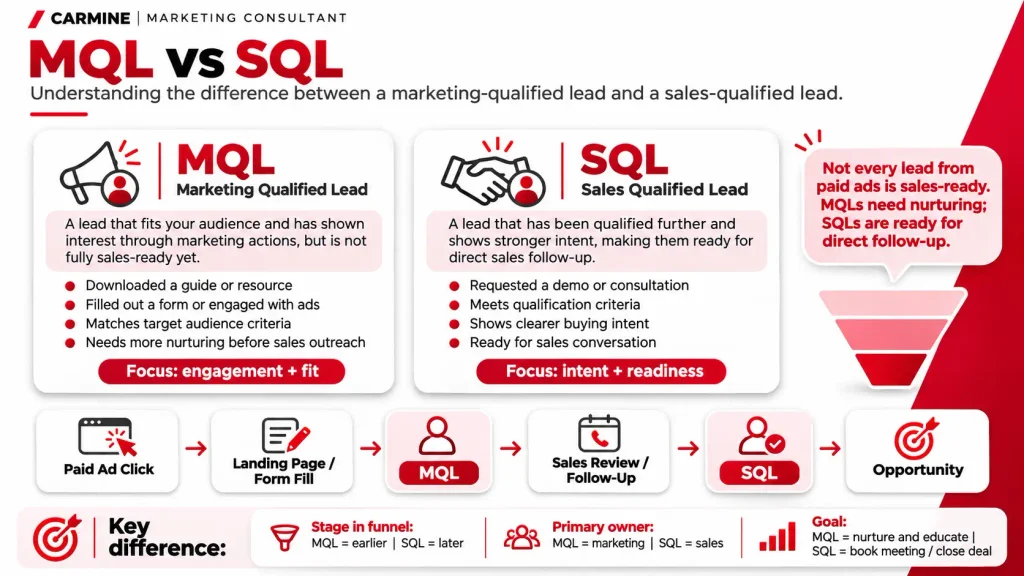
An MQL (marketing-qualified lead) meets your marketing team’s agreed criteria for a sales handoff. An SQL, or sales-qualified lead, has been qualified by sales as a potential customer.
That distinction follows HubSpot’s lifecycle-stage definitions. Your business still needs to specify the evidence required at each stage.
One thing I’ve learned working in and consulting B2B companies, is that every business defines it differently.
| Question | MQL | SQL |
|---|---|---|
| Who qualifies the lead? | Marketing, using agreed rules | Sales, using agreed qualification criteria |
| What does it establish? | Enough fit and relevant interest to warrant a handoff | A credible potential customer based on sales qualification |
| Possible evidence | Suitable company and a relevant request | Confirmed need, service fit, and a viable next step |
| What it does not establish | That a download or score proves buying intent | That a deal is guaranteed to close |
| Useful paid-media metric | Cost per MQL | Cost per SQL and progression to revenue |
A meeting booked is not automatically an SQL. The prospect might be outside your market or fail to attend. Likewise, a lead score of 80 means little unless the scoring rules predict something commercially useful.
For the examples below, I’ll use an SQL definition that requires sales to verify fit and need and record an agreed next step. That is a working definition, not a universal standard.
Define the Stages Before Comparing Campaigns
Imagine one marketer calls every webinar registration an MQL. Another requires the right company size and a consultation request. Comparing their cost per MQL would be misleading.
Write down the entry rule, evidence, owner, and timestamp for each stage. Keep the rules stable during a reporting period, and annotate any changes.
| Stage | Example entry rule | What to record |
|---|---|---|
| Raw lead | A unique inquiry or registration is captured | Original source, campaign, offer, and creation date |
| MQL | Fit requirements plus sufficient relevant intent | Qualification evidence and first MQL date |
| Sales accepted | Sales agrees to work the lead | Owner and acceptance date |
| SQL | Sales verifies fit and need with an agreed next step | Qualification notes and first SQL date |
| Opportunity | A distinct potential deal meets your opportunity criteria | Deal ID, amount, stage, and creation date |
| Customer | A deal closes successfully | Closed-won date and agreed revenue measure |
Sales accepted is optional. It can be useful when you need to distinguish leads waiting in a queue from leads that sales reviewed and qualified.
Keep disposition separate from lifecycle history. “No response,” “bad timing,” and “not a fit” describe different situations. A previously qualified contact who needs six months should not disappear from historical conversion reporting.
If you’re mapping the wider buyer journey, my Nike marketing funnel breakdown shows why different interactions serve different purposes.
Use Fit and Intent Together
Fit asks whether this person or company could benefit from what you sell. Intent asks whether their behavior suggests a relevant next step now.
- Fit: supported geography, company profile, use case, and commercially viable needs.
- Intent: a specific request, product evaluation, substantive reply, or other meaningful buying behavior.
- Exclusions: confirmed spam, irrelevant requests, unsupported needs, or other explicit disqualifiers.
- Unknowns: missing information that still needs verification.
Don’t let repeated low-value activity compensate for a hard fit failure. Ten email opens should not qualify someone in a market you can’t serve.
Also, don’t assume every personal email address is junk. Small-business owners may use one. Choose criteria that reflect your actual customers.
For a B2B service, a suitable company downloading one guide might enter nurture. A suitable company describing an active project might go straight to sales. Fast-moving prospects don’t need to wait through artificial stages, but you should document how they appear in funnel reports.
Your ad copy should help the right prospects recognize themselves. My B2B copywriting examples show how specific problems and business outcomes can make an offer clearer.
The Metrics That Measure Paid Ads Lead Quality
Okay, now let’s talk KPIs. What exactly should you be measuring to improve performance?
Start with unique, deduplicated leads. Track invalid submissions separately so you can see the cost of generating them. Don’t silently remove bad leads and present the cleaned number as total acquisition performance.
| Metric | Calculation | What it helps you assess |
|---|---|---|
| Cost per lead | Ad spend ÷ unique leads | Initial acquisition cost |
| Lead-to-MQL rate | Leads reaching MQL ÷ leads in the same cohort × 100 | Fit and qualification at the marketing stage |
| Cost per MQL | Ad spend ÷ MQLs from that acquisition cohort | Cost of producing marketing-qualified demand |
| MQL-to-SQL rate | MQLs reaching SQL ÷ MQLs in the same cohort × 100 | Progression after the marketing handoff |
| Cost per SQL | Ad spend ÷ SQLs from that acquisition cohort | Cost of producing sales-qualified demand |
| SQL-to-customer rate | SQLs becoming customers ÷ SQLs in the same cohort × 100 | Commercial outcomes after sales qualification |
| Media CAC | Ad spend ÷ acquired customers | Advertising cost per new customer |
If a denominator is zero, report the rate or cost as unavailable rather than zero. Zero cost per SQL would imply free qualified leads, not an absence of them.
Add sales-acceptance rate, meeting attendance, time to first contact, stage velocity, and rejection reasons when they help explain a problem. You don’t need every metric on the main dashboard.
Media CAC excludes salaries, agency fees, creative production, and other acquisition costs. Label it clearly. A fully loaded CAC calculation needs those costs and a consistent allocation method.
A Campaign Comparison: Cheap MQLs, Expensive SQLs
Consider two campaigns with equally mature lead cohorts.
| Metric | Campaign A | Campaign B |
|---|---|---|
| Ad spend | $10,000 | $10,000 |
| Unique leads | 250 | 100 |
| MQLs | 100 | 60 |
| SQLs | 10 | 20 |
| Customers | 2 | 5 |
| Cost per lead | $40 | $100 |
| Cost per MQL | $100 | $166.67 |
| MQL-to-SQL rate | 10% | 33.3% |
| Cost per SQL | $1,000 | $500 |
| Media CAC | $5,000 | $2,000 |
Campaign A looks better in a lead report and an MQL report. Campaign B produces twice as many SQLs and more customers from the same budget.
Assuming comparable customer value and attribution, B has better acquisition economics in this example. But I’d still inspect sample size, deal quality, sales handling, and whether its results can hold at higher spend before moving the entire budget.
There’s also a useful diagnostic in A’s numbers: marketing qualified 100 leads, but only ten became SQLs. That could mean the MQL rule is too permissive, the offer attracts the wrong intent, or sales isn’t working the leads effectively. The conversion rate tells you where to investigate, not who to blame.
Why a Low CPL Benchmark Doesn’t Prove Quality
WordStream/LocaliQ’s 2026 search advertising benchmarks report a $66.69 average cost per lead and an 8.18% conversion rate across more than 13,000 US-based campaigns.
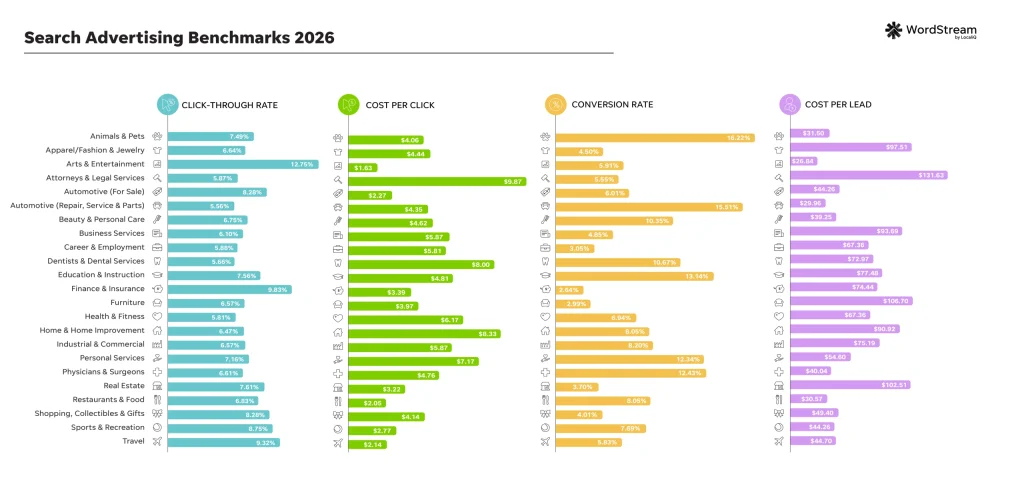
While they are not MQL/SQL benchmarks, most opportunities start off as a basic lead and you need to measure them as well.
Imagine a $66.69 CPL with 10% of leads reaching SQL implies $666.90 per SQL. At a 25% lead-to-SQL rate, it implies $266.76 per SQL.
That’s why I’d be cautious with a universal “good MQL-to-SQL rate.” Offer, market, qualification rules, sales capacity, and cohort age can all change it.
Calculate the Qualification Rate Your Economics Require
Instead of adopting somebody else’s target, work backward from your own acquisition allowance.
Allowable cost per SQL = allowable media CAC × SQL-to-customer rate.
If you can afford $3,000 in advertising to acquire a customer and 20% of SQLs become customers, your allowable cost per SQL is $600.
Required MQL-to-SQL rate = cost per MQL ÷ allowable cost per SQL.
At $150 per MQL and a $600 allowable cost per SQL, you need 25% of MQLs to become SQLs, assuming that funnel path and those economics hold.
Use comparable mature cohorts, and leave room for uncertainty. If the resulting required rate exceeds 100%, the economics cannot work under those assumptions. You need a lower acquisition cost, better downstream conversion, or more customer contribution.
The acquisition allowance itself should reflect margins, cash flow, retention, and payback requirements. Don’t use total lifetime revenue as if it were money available to spend immediately.
Suppose you generate 100 MQLs in September and sales qualifies 30 leads during September. It is tempting to report a 30% MQL-to-SQL rate.
But what if 20 of those SQLs came from August? The numerator and denominator no longer describe the same group. This is a common challenge.
For a cohort report, start with a defined set of MQLs and follow those records. For example: September MQLs that reached SQL within 30, 60, or 90 days. Use stage-entry dates and allow the full observation window before treating the cohort as mature.
A separate operational report can show SQLs created this week. That is useful for sales workload and pipeline planning, but it isn’t a cohort conversion rate.
- Report counts alongside percentages; two SQLs from four MQLs is a very small sample.
- Use comparable observation windows when evaluating campaigns.
- Show pending or not-yet-reviewed leads separately from disqualified leads.
- Version your qualification rules so a definition change does not masquerade as performance improvement.
- Count distinct opportunities at the deal level; five contacts attached to one deal are not five opportunities.
In B2B, decide whether qualification is tracked at contact or account level. If you use both, label each clearly and avoid adding their totals together.
Build a Lead-Quality Dashboard You Can Act On
I’d start with one row per campaign and acquisition cohort, then break out offer and audience where there is enough data.
| Dashboard group | Fields to include |
|---|---|
| Acquisition | Period, campaign, channel, offer, spend, unique leads |
| Qualification | MQLs, accepted leads, SQLs, stage-conversion rates |
| Sales outcomes | Distinct opportunities, customers, and attributable revenue |
| Economics | CPL, cost per MQL, cost per SQL, and media CAC |
| Operations | Response time, pending reviews, no-shows, and rejection reasons |
| Data quality | Missing sources, duplicates, unmapped stages, and failed imports |
Choose one attribution method for the main cross-channel report and document it. First touch, lead-creation touch, and multi-touch credit can produce different campaign totals. None is a direct measure of causality.
Avoid summing platform-reported conversions into a company-wide customer count. More than one platform may claim the same person.
For a broader perspective on channel investment, marketing mix modeling can complement lead-level attribution when the business has suitable data. For weekly lead-quality decisions, consistent CRM records remain the practical starting point.
Return Qualified Outcomes to Your Ad Platforms
If your ad system only receives form submissions, its optimization signal does not distinguish a valuable inquiry from a poor one. Better reporting helps the team; feeding back qualified outcomes can also improve the information available to bidding.
Google’s enhanced conversions for leads documentation describes matching imported offline outcomes using hashed first-party customer data and identifiers such as GCLID. Use a supported integration and validate the diagnostics rather than assuming a connected CRM means the data is correct.
Define the event before building the integration: what causes it, when it occurred, which record it belongs to, and how duplicates are prevented. Keep source identifiers and event timestamps where supported and appropriate.
Respect consent and the platform’s data requirements. Hashing customer information is part of the matching process; it is not a replacement for permission to use that data.
For Meta or LinkedIn, review the supported CRM and conversion integrations for your account and the campaign objective. The principle is the same: send verified commercial outcomes and check delivery, matching, and reporting.
Should You Optimize for MQLs or SQLs?
Use the deepest meaningful signal that is measured reliably and arrives often and promptly enough to support the campaign’s optimization.
SQLs are closer to revenue, but three delayed SQLs a month may provide a weak feedback signal. A well-defined MQL event can be a practical intermediate step while you improve volume and data reliability.
Keep later outcomes in reporting either way. If campaigns become better at generating MQLs while cost per customer deteriorates, the proxy needs review.
Avoid treating every stage reached by one person as a separate equal-value business win. A lead becoming an MQL, SQL, and customer is one progressing relationship. Review bidding-goal configuration so accumulated stage events don’t unintentionally reward the wrong behavior.
Diagnose the Reason Leads Fail to Progress
A rejection menu is more useful than a notes field full of “bad lead.” I’d use a short list of reasons that lead to different actions.
| Observed problem | What to investigate | Possible response |
|---|---|---|
| Wrong company or service need | Query, targeting, offer, and page language | Narrow intent or make eligibility clearer |
| Many content downloads, few sales conversations | Whether the offer implies buying intent | Nurture the audience and revise MQL rules |
| Qualified-looking leads receive no contact | Routing, ownership, and response coverage | Fix the handoff before judging traffic |
| Frequent no-shows | Scheduling friction and expectations | Improve confirmation and qualification |
| SQLs rarely become opportunities | Sales qualification consistency and actual fit | Review calls and stage-entry evidence |
| Opportunities stall at price | Positioning, deal economics, and buyer expectations | Set expectations earlier and inspect sales feedback |
Keep “not reached” separate from “not qualified.” A salesperson who made one attempt has learned little about the buyer’s fit.
Review response times by campaign too. If one channel’s leads arrive after hours and another’s arrive during staffed hours, the sales process may explain part of the apparent quality difference.
Agree on a practical response commitment, coverage, escalation, and the evidence required before closing a lead as unreachable. Then check whether the team follows that process.
Improve Quality Without Making Every Form Painful
More form fields can reduce volume without improving the customers you acquire. Add questions because they support routing or qualification, not because a longer form feels more serious.
- Ask about the use case when it determines whether you can help.
- State the service area or customer profile when it prevents mismatched inquiries.
- Set realistic expectations about pricing and the next step.
- Use spam controls that do not obstruct legitimate prospects.
- Compare form variants on qualified outcomes, not submission rate alone.
Keep creative and the landing page consistent. A free-template promise should not unexpectedly become a sales consultation after submission. That mismatch creates frustrated prospects and misleading lead counts.
Also check whether broader targeting is truly the problem. A vague offer can attract the wrong people even inside a narrowly defined audience.
A Weekly Lead-Quality Review
I’d give marketing and sales a short shared review built around actual records:
- Inspect a sample of accepted, rejected, and pending leads from each meaningful campaign.
- Check whether the qualification evidence matches the written rules.
- Review cost per SQL and downstream outcomes for mature cohorts.
- Identify the largest rejection or operational bottleneck.
- Assign one or two changes with an owner and a measurement plan.
Don’t change the MQL threshold merely to hit a volume target. If you revise it because the evidence supports a better rule, record the date and keep historical comparisons interpretable.
Likewise, don’t cut a promising campaign after one poor week in a long sales cycle. Separate urgent problems, such as spam or broken routing, from changes that require more outcome data.
Frequently Asked Questions
Is an MQL better than a lead?
An MQL should contain more evidence of fit and relevant interest than a raw lead. Whether it is actually more valuable depends on how well your qualification criteria predict sales outcomes.
Is an SQL the same as an opportunity?
Not necessarily. An SQL is sales-qualified; an opportunity usually represents a distinct potential deal that meets additional criteria. Some businesses combine these stages, but the reporting definitions should say so.
What is a good MQL-to-SQL conversion rate?
There is no useful universal number without comparable definitions, offers, and observation windows. Start with mature internal cohorts and calculate the rate required by your acquisition economics. Treat outside benchmarks as context.
Does a demo request automatically become an SQL?
Only if your agreed definition says so and the required qualification has occurred. A request demonstrates interest, but fit, need, and viability may still be unknown.
Can I measure lead quality without a sophisticated CRM?
Yes. A controlled spreadsheet with unique lead IDs, source, creation date, stage-entry dates, qualification reasons, and outcomes can support a small operation. Limit access appropriately and move to a more reliable system as volume and complexity grow.
Measure What Happens After the Form
MQL and SQL labels are useful when they represent evidence. The important work is agreeing on that evidence, capturing it consistently, and tracing paid-media spend through to customers.
Start with a clear definition, a mature cohort, and a cost-per-SQL calculation. Then inspect the records behind the number. You’ll have a much better basis for deciding which campaigns to scale and which problems to fix.
If you need help improving paid ads lead quality or connecting campaigns to qualified opportunities and revenue, get in touch to schedule a consultation. We can review your qualification rules, tracking, and campaign economics to identify what needs to change.