


Attribution looks simple when a customer clicks one ad and converts five minutes later.
It gets messy when that same customer discovers your company through a Meta ad, reads a blog post, joins your email list, searches your brand on Google, and finally submits a form through a remarketing campaign.
Which ad deserves the conversion?
First-click attribution gives the credit to the ad that started the journey. Last-click attribution gives it to the ad that finished it. Both models are easy to understand, but they can produce completely different versions of your paid advertising performance.
In this guide, I’ll break down first-click vs. last-click attribution, show you where each model helps, and explain the approach I recommend when managing paid campaigns.
Let’s jump into it!
First-Click vs. Last-Click Attribution: The Quick Answer
First-click attribution assigns 100% of a conversion to the first tracked interaction. It is useful for learning which campaigns introduce new prospects to your business.
Last-click attribution assigns 100% of a conversion to the final tracked click before the conversion. It is useful for seeing which campaigns capture demand and close the journey.
Neither model tells the complete story, though.
First-click can overvalue awareness campaigns that attract attention but do little to move buyers forward. Last-click can overvalue branded search, remarketing, and other channels that collect demand created somewhere else.
My short answer is to use both as reporting perspectives, not as competing versions of the truth. For Google Ads bidding, data-driven attribution is generally the more practical default when the tracking and conversion data are reliable.
Let’s get into the nitty gritty of both now.
What Is First-Click Attribution?
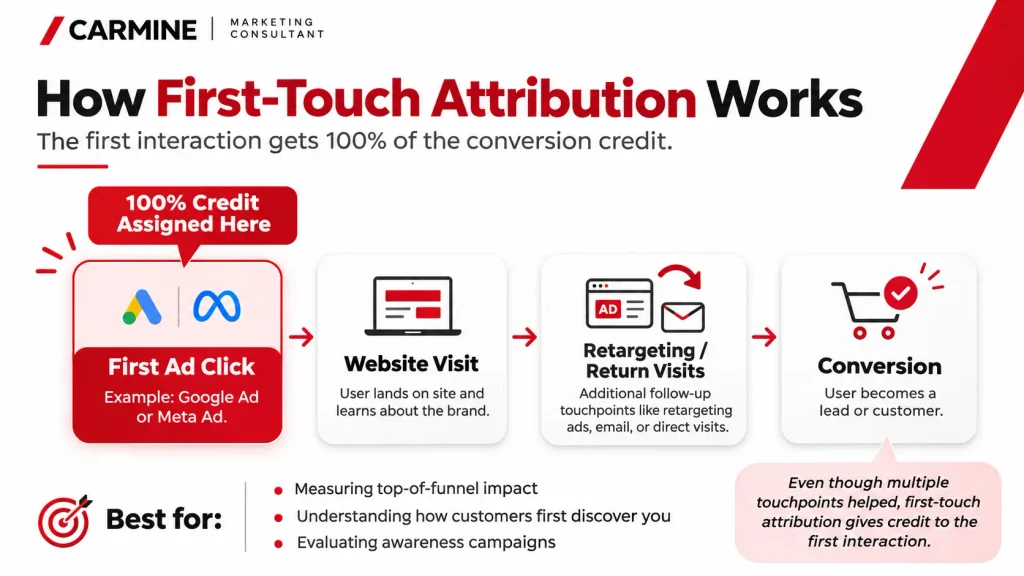
First-click attribution (also called first-touch attribution in many reports) gives all conversion credit to the earliest recorded source, campaign, or ad that brought someone into the funnel.
Imagine a software buyer follows this path:
- Clicks a LinkedIn ad promoting an industry report.
- Returns through an email two weeks later.
- Clicks a non-branded Google Search ad.
- Later searches the company’s name and clicks a branded ad.
- Books a demo.
Under first-click attribution, LinkedIn receives 100% of the credit. The model answers a useful question: What originally introduced this buyer to us?
That makes first-click reporting helpful for evaluating prospecting campaigns, broad non-brand keywords, video, paid social, content promotion, and other tactics designed to generate awareness rather than capture an immediate conversion.
Advantages of First-Click Attribution
- It identifies acquisition sources. You can see which campaigns are bringing genuinely new prospects into your funnel.
- It gives prospecting campaigns more visibility. Upper-funnel ads are less likely to disappear behind branded search or remarketing.
- It is easy to explain. There is no complicated weighting system or fractional conversion credit.
- It can guide growth budgets. If the goal is reaching new audiences, the first interaction deserves attention.
Weaknesses of First-Click Attribution
The first click may have started the journey without contributing much beyond that point. A broad social ad could attract thousands of inexpensive visitors while search, email, sales outreach, and product content do the harder work of creating the conversion.
Giving the first ad all the credit can make low-intent traffic look more valuable than it is. It also ignores the campaigns that educate, nurture, and convert the prospect.
There is another practical issue: the “first” click is only the first one your tracking system can see. Cookie expiration, consent settings, device changes, browser restrictions, and offline interactions can hide what actually happened first.
What Is Last-Click Attribution?
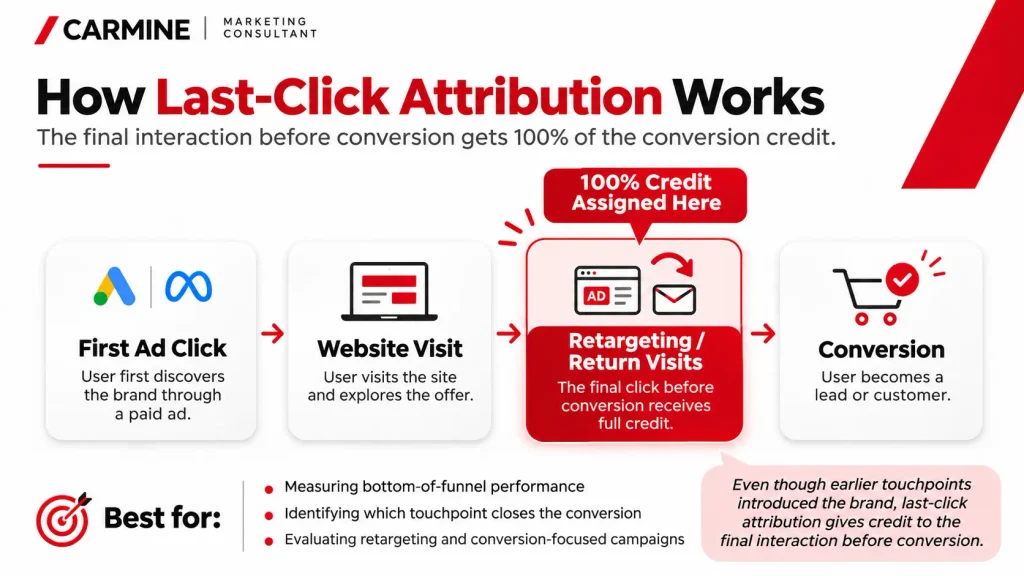
Last-click attribution gives 100% of the credit to the final tracked ad click before a lead or sale.
Using the same example, the branded Google Search ad would receive the conversion. LinkedIn, email, and the non-branded search campaign would receive nothing.
The question changes from “How did this person discover us?” to “Which click happened immediately before the conversion?”
Advantages of Last-Click Attribution
- It is simple and actionable. Marketers can quickly connect conversions to campaigns, ads, and keywords.
- It works reasonably well for short journeys. If most customers convert during their first visit, the first and last click may be the same.
- It highlights demand-capture tactics. High-intent search, remarketing, and offer-driven campaigns are easier to evaluate.
- It requires less tracking complexity. You do not need a perfect record of every earlier interaction to identify the final click.
Weaknesses of Last-Click Attribution
Last-click attribution tends to reward the channels closest to the conversion.
Branded search is the classic example. Someone might discover a company through a YouTube campaign, read several articles, receive three emails, and then search the brand name when they are ready to buy. The branded ad gets the conversion even though it did not create the original demand.
If you make budget decisions from that report alone, you may cut the campaigns filling the funnel and increase spending on the campaigns harvesting it. Performance can look better temporarily, right before the number of new prospects begins to shrink.
First Click vs. Last Click at a Glance
| Question | First Click | Last Click |
|---|---|---|
| Who receives credit? | The first tracked interaction | The final tracked click |
| Best use | Understanding discovery and acquisition | Understanding conversion and demand capture |
| Often favors | Prospecting, social, video, and non-brand campaigns | Brand search, remarketing, affiliates, and high-intent campaigns |
| Main blind spot | Everything that nurtures and closes the buyer | Everything that creates and develops demand |
| Complexity | Low | Low |
| Conversion credit | 100% to one touchpoint | 100% to one touchpoint |
Why the Attribution Model Changes Paid Ad Decisions
Attribution is not an accounting exercise. It affects which campaigns receive budget, which ads get paused, and what your team believes is driving growth.
Here are four situations where the model can change the conclusion.
1. Paid Social Creates Demand That Search Captures
A prospect sees a Meta or LinkedIn ad but does not convert. Days later, the person searches for your service and clicks a Google ad.
First click credits paid social. Last click credits paid search. Both channels played a role, but a single-touch report makes one appear irrelevant.
This is especially important when comparing channels with different jobs in the marketing funnel. Expecting an awareness campaign to perform like branded search is not a fair test.
2. Branded Search Receives Too Much Credit
Branded search often produces excellent conversion rates and a low cost per acquisition. Some of that performance is absolutely real. Protecting your brand, controlling the message, and directing people to the right landing page can be valuable.
However, branded search usually reaches people who already know the company. Last-click reporting can make it look like the brand campaign created sales that were actually generated by referrals, content, paid social, non-brand search, or offline activity.
I prefer to report brand and non-brand search separately. Blending them can hide how much it really costs to acquire new demand.
3. Remarketing Looks Like a Growth Engine
Remarketing reaches people who have already visited your website or interacted with your brand. It can improve conversion efficiency, but it depends on another source creating the audience first.
Last-click attribution can give remarketing most of the credit. First-click attribution can give it almost none. The honest interpretation is usually between those extremes: remarketing assists conversion, while prospecting supplies the people it can reach.
4. Multiple Platforms Claim the Same Conversion
Meta, Google, LinkedIn, and other platforms each observe a different portion of the journey. Their attribution windows, identity matching, view-through rules, and modeled conversions also differ.
A buyer could interact with ads on three platforms before submitting one form. Each platform may claim influence over that conversion. Adding the platform totals together can therefore produce more reported conversions than the business actually received.
This is why I use platform reporting to optimize within each ad system, then use analytics and CRM data to judge cross-channel performance.
An Important Google Ads and GA4 Detail
First-click attribution remains a useful measurement concept, but it is no longer a selectable attribution model inside Google Ads.
According to Google’s current attribution documentation, first click, linear, time decay, and position-based models are no longer supported. Google Ads currently supports last-click and data-driven attribution, with data-driven attribution used by default for most conversion actions.
GA4 made a similar change. Its first-click, linear, time-decay, and position-based reporting models were removed in November 2023. Do not be surprised if an older tutorial tells you to select a model that is no longer available.
You can still analyze acquisition with first-user dimensions, stored first-touch fields in a CRM, dedicated attribution software, or your own reporting model. Just separate the broader measurement concept from the attribution-model dropdown inside Google’s products.
What Is Data-Driven Attribution?
This is where attribution gets interesting (if it isn’t already!)
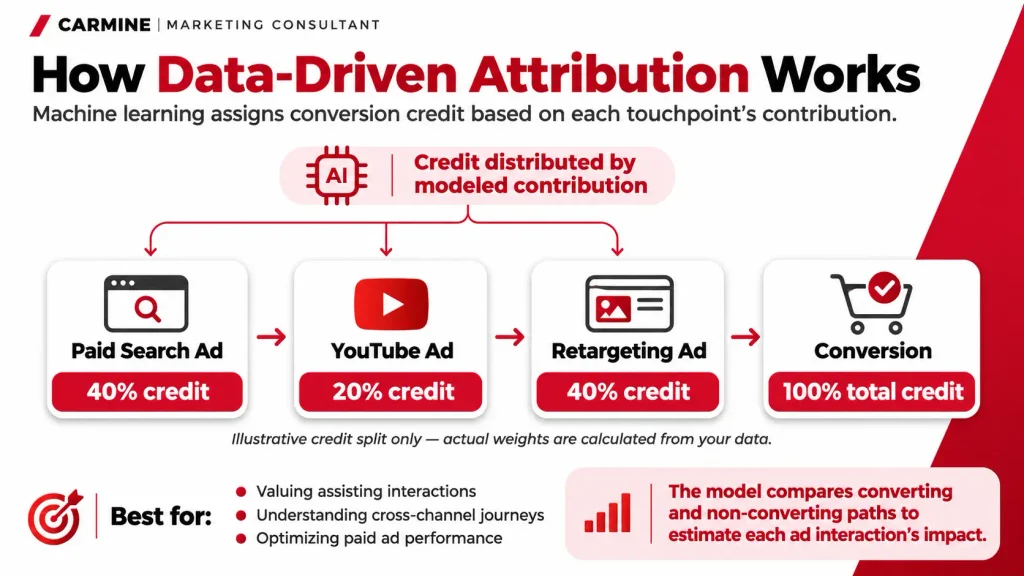
Data-driven attribution distributes credit based on the observed contribution of different ad interactions instead of assigning everything to the first or last click.
Google compares the paths of users who convert with those who do not, then looks for patterns among the ads, keywords, campaigns, clicks, and eligible video engagements involved. Conversion credit can be split between multiple interactions.
It gives you a much more holistic view of touch points during the marketing funnel.
For example, one conversion might appear as 0.3 conversions for an earlier non-brand campaign and 0.7 for the later brand campaign. The fractions still add up to one conversion.
Google says all conversion actions are eligible for data-driven attribution, although its documentation notes that the model improves with more data.
Data-driven attribution is useful, but it is not a perfect source of truth. It works inside the data and channels Google can observe. It does not magically solve cross-platform duplication, offline influence, missing consent, weak conversion tracking, or the difference between a lead and actual revenue.
Which Attribution Model Should You Use?
Here’s the million dollar question. The right answer depends on the decision you are trying to make.
Use First-Click Reporting to Evaluate Acquisition
Look at first-click or first-touch data when you want to understand:
- Which channels introduce new people to the company.
- Which campaigns generate new names, accounts, or opportunities.
- Whether prospecting spend is expanding your reachable market.
- Which non-brand topics and messages create initial interest.
Whenever possible, filter the report to new customers or qualified opportunities. A campaign that creates a large number of first visits is not necessarily creating valuable demand.
Use Last-Click Reporting to Evaluate Demand Capture
Last-click data is useful when you want to know:
- Which campaigns appear immediately before conversions.
- Which high-intent keywords and offers capture existing demand.
- Where landing-page or conversion-rate improvements may have the greatest impact.
- How short, direct-response journeys perform.
Treat it as a closing report, not proof that the final click created the entire sale.
Use Data-Driven Attribution for Google Ads Optimization
For most properly tracked Google Ads accounts, I would begin with data-driven attribution. It gives automated bidding more information about the interactions that contribute to conversions.
I would consider last click when there is a specific reason to use a simpler model, such as a very short customer journey or a measurement setup that the team cannot reliably validate. Even then, I would compare models before changing bidding or reallocating a large budget.
The Paid Ads Measurement Stack I Recommend
I do not rely on one attribution column to make every decision. I use several layers, with each one answering a different question.
Layer 1: Platform Data for Campaign Optimization
Use Google Ads, Meta Ads, LinkedIn Campaign Manager, and other native platforms to optimize ads within that platform. Their conversion data is timely and gives bidding systems the signals they need.
Do not add every platform’s reported conversions together and call the result total company conversions.
Layer 2: Analytics for Cross-Channel Journeys
Use GA4 or another analytics platform to compare channels under a consistent set of rules. Review first-user acquisition, session acquisition, conversion paths, and model-comparison reports.
Keep UTM naming consistent. If one team uses paid-social, another uses paidsocial, and a third leaves the medium blank, even the best model will be working with messy inputs.
Layer 3: CRM Data for Lead Quality and Revenue
A form submission is not the same as a qualified lead, opportunity, sale, or retained customer.
Store the original source, most recent source, campaign identifiers, landing page, and click IDs in your CRM. Then connect advertising data to business outcomes such as:
- Qualified lead rate.
- Cost per sales-qualified lead.
- Opportunity creation.
- Pipeline generated.
- Closed revenue.
- Customer acquisition cost.
- Lifetime value and payback period.
This is the layer that stops cheap, low-quality leads from looking like great performance. It also connects attribution to the broader work of marketing mix modeling and revenue measurement.
Layer 4: Experiments for Incrementality
Attribution asks who receives credit for a conversion that occurred. Incrementality asks whether the conversion would have happened without the advertising.
That distinction matters. A branded ad can receive perfect last-click credit from a customer who would have purchased through the organic result anyway.
Geo tests, audience holdouts, conversion-lift studies, matched-market tests, and controlled budget changes can help estimate causal impact. They require more planning, but they answer questions that click-path attribution cannot.
A Simple Attribution Example With Numbers
Suppose a company spends $20,000 across three campaigns:
| Campaign | Spend | First-Click Leads | Last-Click Leads |
|---|---|---|---|
| Paid social prospecting | $8,000 | 80 | 20 |
| Non-brand search | $9,000 | 45 | 70 |
| Branded search | $3,000 | 5 | 40 |
Under first-click attribution, paid social looks strongest at $100 per lead. Branded search looks weakest at $600 per lead.
Under last-click attribution, branded search looks strongest at $75 per lead. Paid social looks weakest at $400 per lead.
Which report is correct? Mathematically, both are. Strategically, neither is enough.
I would want to know how many of those leads became qualified opportunities, whether branded search conversions were influenced by paid social, how often the same lead appears in multiple platform reports, and what happened to total conversions when prospecting spend changed.
If paid social is paused based only on last-click cost per lead, branded search volume may fall several weeks later. If branded search is paused based only on first-click performance, the company may lose an efficient way to capture demand it already created.
How to Set Up Better Paid Ads Attribution
1. Define the Conversion That Matters
Choose a primary business outcome. For ecommerce, that may be a purchase with revenue. For lead generation, it could be a qualified lead, booked meeting, opportunity, or closed customer.
Micro-conversions such as page views, button clicks, and time on site can help diagnose behavior, but they should not carry the same weight as revenue-producing actions.
2. Standardize UTMs and Campaign Names
Create one naming convention for source, medium, campaign, content, and term. Document it. Use it across every channel.
Clear naming makes attribution reports easier to audit and prevents the same channel from being split into several rows.
Here’s a free UTM generator that I’ve been using for years.
3. Capture Click IDs and Original Source
Store identifiers such as GCLID, GBRAID, WBRAID, and platform-specific click data when appropriate. Preserve both original-source and latest-source fields instead of overwriting the first touch every time someone returns.
4. Connect the CRM and Ad Platforms
Send qualified-lead, opportunity, and revenue outcomes back to the platforms when privacy requirements and your setup allow it. Paid media algorithms should learn from valuable conversions, not every form submission equally.
5. Compare Models Before Moving Budget
Build a simple comparison showing first touch, last touch, data-driven credit, spend, leads, qualified leads, and revenue by channel.
Large differences are not necessarily tracking errors. They often reveal the role each channel plays in the journey.
6. Segment Brand and Non-Brand Search
This is one of the fastest ways to improve a paid search report. Brand campaigns mostly capture existing awareness, while non-brand campaigns are more likely to create or intercept new demand.
7. Review Performance Over the Full Sales Cycle
A campaign launched last week may have generated clicks and leads but no closed revenue yet. This is common in B2B and high-ticket services.
Match your reporting window to the time it normally takes someone to become a customer. Otherwise, recent campaigns will always appear worse than mature ones.
Common Attribution Mistakes
- Treating platform-reported conversions as deduplicated company results.
- Optimizing for all leads without measuring quality.
- Comparing channels that perform different funnel roles using one KPI.
- Allowing branded search to hide non-brand acquisition costs.
- Changing models and assuming campaign performance changed. The business results may be identical; only the credit assignment changed.
- Ignoring view-through conversions. They can reveal influence, but they also require careful interpretation because a view is weaker evidence than a click.
- Using a sophisticated model on unreliable tracking. Complexity does not repair missing tags, duplicate events, inconsistent UTMs, or bad CRM data.
Frequently Asked Questions
Is first-click or last-click attribution more accurate?
Neither is universally more accurate. First click accurately identifies the earliest tracked interaction, while last click accurately identifies the final tracked click. The mistake is treating either interaction as proof that one channel caused the entire conversion.
Is first-click attribution still available in Google Ads?
No. Google Ads discontinued first-click, linear, time-decay, and position-based attribution models. Its supported choices are data-driven and last click, with data-driven used by default for most conversion actions.
What attribution model should I use for Google Ads?
Data-driven attribution is a sensible starting point for most accounts with reliable conversion tracking. Review last-click results as a comparison, and use CRM outcomes to make sure Google is optimizing toward conversions that produce business value.
There is no single best model. Use platform data for ad-level optimization, first-touch reporting to understand discovery, cross-channel analytics to compare sources consistently, and experiments to estimate incremental impact. Pay attention to view-through attribution windows because they can materially change reported results.
Can first click and last click be the same?
Yes. If someone clicks an ad and converts without another tracked marketing interaction, that ad is both the first and last click. The models tend to diverge more as sales cycles become longer and more channels are involved.
What is last non-direct click attribution?
Last non-direct click gives credit to the most recent identifiable marketing source instead of assigning it to a direct visit. This can be useful when a prospect returns by typing the URL or using a bookmark after an earlier campaign created the visit.
Final Thoughts on First-Click vs. Last-Click Attribution
First-click attribution shows where the journey began. Last-click attribution shows where the final tracked click occurred. That is useful information, but it is not the same as measuring everything that influenced the buyer.
Use first-click reporting to understand acquisition. Use last-click reporting to understand demand capture. Use data-driven attribution to give Google Ads more context for optimization, then validate performance against qualified leads, pipeline, revenue, and controlled experiments.
The goal is not to find one attribution model that settles every argument. It is to build a measurement system that helps you make better budget decisions.
If you need help setting up, managing, or improving your paid advertising campaigns, get in touch to schedule a consultation.