


A $30 lead from Facebook looks better than a $90 lead from Google. Until you find out the Google leads become customers four times as often.
That’s the problem with choosing between paid search and paid social based on the advertising dashboard alone. You can buy cheaper clicks and still pay more for every customer.
When I compare these channels, I start with the buyer: what they need, whether they’re looking for it, and what has to happen before they’ll spend money. Then I work through the economics.
Here’s how paid search vs paid social compares, what the benchmark data actually tells us, and how I’d decide where to put the next dollar.
Paid Search vs Paid Social: What’s the Difference?
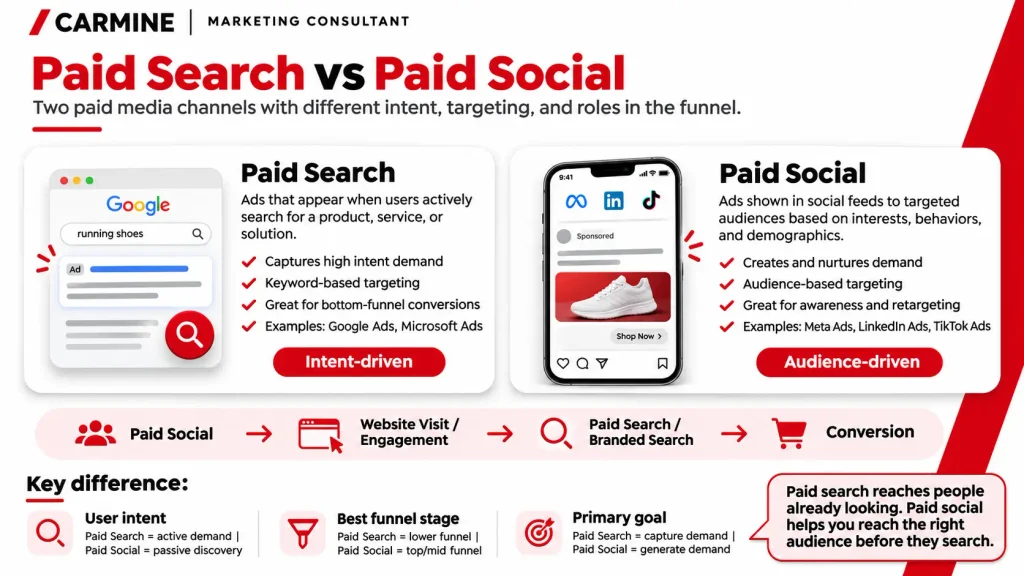
Paid search places ads in front of people searching for something. Think Google, Bing, etc.
Paid social places ads in social platforms using audience signals and predicted behavior to reach potential buyers. This is your Facebook, Instagram, TikTok, and so on.
Search gives you a clue about the person’s current question. Social gives you a way to reach people who may fit the offer even when they haven’t searched for it.
A search for “emergency plumber near me” means an immediate problem. A bathroom renovation video in an Instagram feed can introduce an idea someone hadn’t planned to research that morning.
That distinction is useful, but it isn’t a hard rule about intent. Plenty of searches are informational. Plenty of social ads generate immediate purchases.
| Comparison | Paid search | Paid social |
|---|---|---|
| Typical context | A person enters a query | A person browses a feed, video, or other social placement |
| Core opportunity | Respond to expressed demand | Reach and persuade a relevant audience |
| Common platforms | Google and Microsoft search advertising | Meta, LinkedIn, TikTok, and others |
| Creative work | Query-relevant copy, assets, offers, and landing pages | Images, video, copy, demonstrations, and offers |
| Common constraint | Profitable search volume and auction costs | Creative performance, audience response, and economics |
| Useful business metrics | Qualified leads, acquisition cost, revenue, and profit | Qualified leads, acquisition cost, revenue, and profit |
What Counts as Paid Search?
Paid search includes sponsored results connected to a search query. Ads on Google and Microsoft are familiar examples; product ads on search results also serve shopping intent.
For a consulting business, queries such as “Google Ads consultant” and “PPC management services” can connect an advertiser with someone evaluating help.
The task is to tell apart those commercial searches from queries about salaries, jobs, free courses, or definitions. All may contain similar words. They don’t all represent your buyer.
Also, Google Ads is a platform, not a catch-all for paid search. It can deliver ads across other environments. Performance Max is a cross-channel campaign type, so comparing all Google Ads spend with social spend isn’t a clean Search-versus-Social test.
What Counts as Paid Social?
Paid social includes advertising on platforms such as Facebook, Instagram, LinkedIn, and TikTok. Depending on the platform and campaign, the ad might send someone to a website, collect a lead through a native form, or promote a purchase.
The work starts with a credible offer and a reason to pay attention. A product demonstration, customer explanation, or specific business problem gives the audience something to evaluate.
Paid social also isn’t one interchangeable channel. A LinkedIn campaign reaching finance leaders and a Meta campaign selling running shoes have different audiences, creative requirements, and costs.
For example, LinkedIn’s targeting documentation describes options based on job title, company, and industry. Those attributes can help marketers reach a defined buying audience. They do not prove someone has budget or is ready to purchase.
What the Cost Data Says
Benchmarks help establish a starting range. They don’t settle which channel will make your business more money.
WordStream/LocaliQ’s 2026 search advertising benchmarks cover more than 13,000 US-based campaigns from April 2025 through March 2026. The reported figures include a $5.42 CPC and $66.69 cost per lead.
Its separate 2025 Facebook advertising study, covering more than 1,000 campaigns, reports $1.92 CPC and $27.66 CPL for leads campaigns. Traffic campaigns had a $0.70 CPC.
| Published dataset | CPC | Cost per lead |
|---|---|---|
| 2026 search benchmarks | $5.42 | $66.69 |
| 2025 Facebook leads campaigns | $1.92 | $27.66 |
| 2025 Facebook traffic campaigns | $0.70 | Not reported for this objective |
Amounts are in US dollars. These are different studies, periods, campaign mixes, and objectives—not a controlled comparison of the same advertisers. The search report covers Google and Microsoft advertising; Facebook figures do not represent all paid social platforms.
The practical lesson is to separate objectives. A campaign optimized to get clicks should not be evaluated as though it were optimized to acquire customers. Don’t turn a low traffic-campaign CPC into a promise of cheap sales.
Use the figures as planning context, then replace them with your own qualified-lead and customer data as it becomes available.
Cheaper Leads Can Produce More Expensive Customers
Here’s a hypothetical comparison. Both campaigns spend $6,000. The social campaign produces three times as many leads.
| Metric | Paid search | Paid social |
|---|---|---|
| Media spend | $6,000 | $6,000 |
| Leads | 60 | 180 |
| Cost per lead | $100 | $33.33 |
| Qualified leads | 30 | 27 |
| Cost per qualified lead | $200 | $222.22 |
| Customers | 6 | 3 |
| Media acquisition cost | $1,000 | $2,000 |
Search wins on customer acquisition in this example. The social campaign’s lower CPL hides a weaker qualification rate and fewer sales.
Now suppose better qualification, a stronger offer, and follow-up bring the social campaign to nine customers from the same spend. Its media acquisition cost becomes roughly $667. The channel decision changes.
Those are illustrative numbers, not client results or forecasts. The point is that the funnel determines what a lead is worth.
Media acquisition cost = ad spend ÷ customers acquired.
Allowable CPL = allowable media acquisition cost × lead-to-customer rate.
If the business can spend $1,200 in media to acquire a customer and closes 5% of leads, the implied CPL ceiling is $60. Use a media allowance that already accounts for the other costs the business needs to cover.
For ecommerce, compare contribution after product costs, fulfillment, refunds, and advertising. Revenue ROAS alone can favor products that generate sales but leave little profit.
When I’d Start With Paid Search
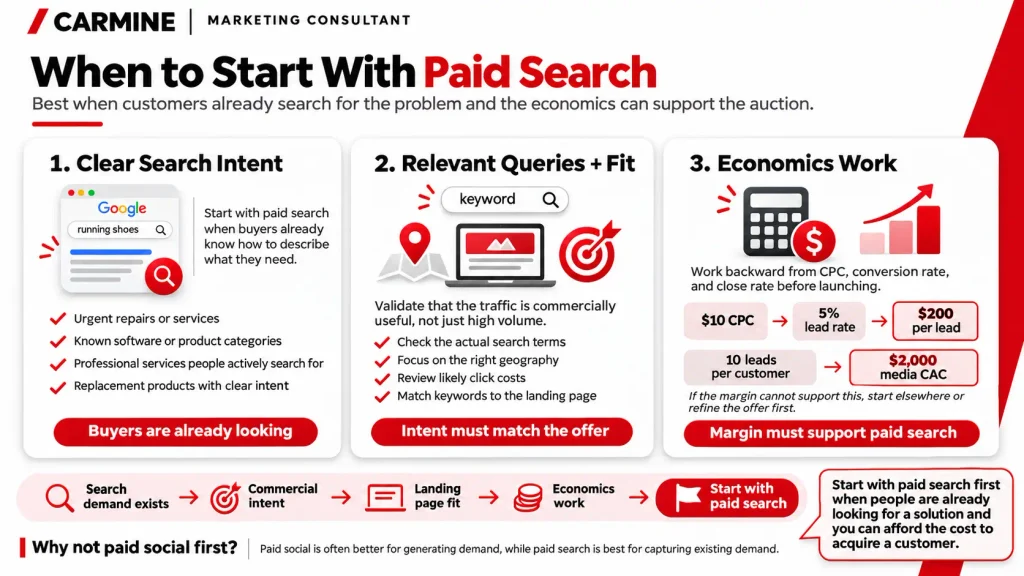
Here are situations where I typically suggest clients to start off with paid search.
Customers already describe the problem clearly
Search is an attractive starting point when buyers use specific terms for what you sell. Examples include an urgent repair, a software category, a professional service, or a replacement product.
Check the actual queries, likely click costs, target geography, and landing-page fit. A large search-volume number is not useful if most searches come from students or people outside your market.
The offer can support the auction cost
High-intent traffic can be expensive. Before launching, work backward from your allowable acquisition cost and realistic conversion rates.
Suppose clicks cost $10 and 5% become leads. That implies $200 per lead before qualification. If only one in ten leads becomes a customer, media acquisition cost is $2,000. The offer needs enough margin to support it.
This is a planning calculation, not a prediction. Use a range of assumptions and revise it with actual results.
You can respond to demand promptly
Search can bring someone who wants an answer now. If calls go unanswered or demo requests wait three days, you can lose that opportunity after paying for it.
I’d check the page, booking process, and sales handoff before concluding that expensive search leads are a channel problem.
When I’d Start With Paid Social
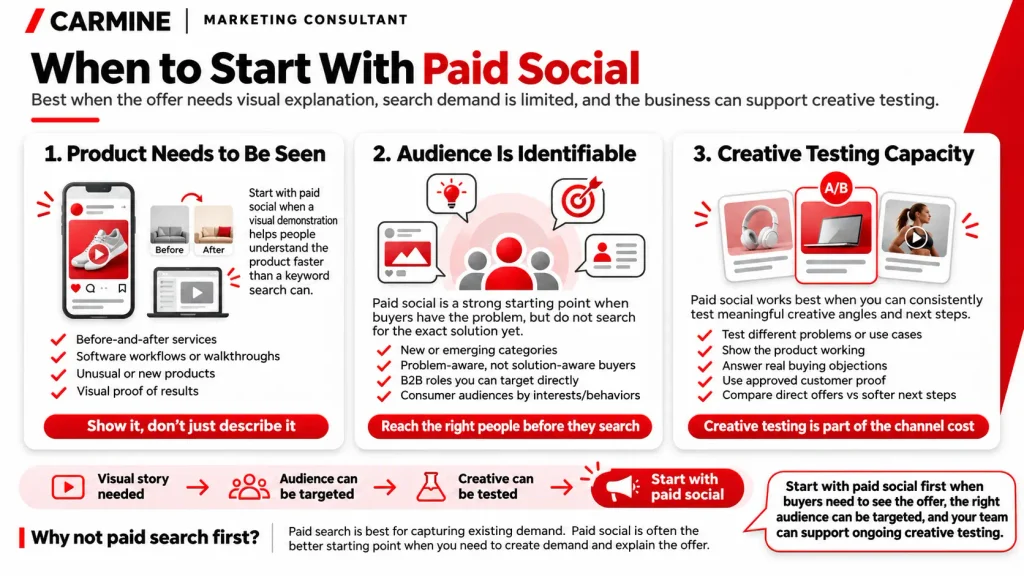
Now, here is when I consider using paid social when working with clients.
The product needs to be seen or explained
A short demonstration can make a product useful in a way a category keyword cannot. Before-and-after work, a clear software workflow, or an unusual physical product may benefit from visual explanation.
The ad still needs a business case. Attention helps only if the audience understands why the offer matters and takes a valuable next step.
The audience is identifiable but search demand is limited
For a new category, buyers may experience the problem without knowing the name of the solution. Waiting for exact product searches would miss much of the potential market.
A B2B campaign can explain the cost of the current process to relevant professionals. A consumer campaign can show a problem and the result of solving it.
The language needs to reflect the buyer’s situation. My breakdown of B2B copywriting examples shows ways to make a complex offer easier to understand.
You can sustain useful creative testing
Social needs a supply of distinct ideas. Changing a button color while repeating the same weak promise won’t teach you much.
- Test different problems or use cases.
- Show the product working.
- Answer a genuine buying objection.
- Use customer evidence you have permission to share.
- Compare an immediate sales offer with a lower-commitment next step when the buying process warrants it.
Include the cost of producing and reviewing those assets in your channel plan. A low media CPC can be less attractive when the team has no capacity to create the ads.
Which Channel Fits Your Business?
| Situation | Where I’d investigate first | What could change the choice |
|---|---|---|
| Urgent local service | High-intent search | Insufficient volume, poor economics, or weak call handling |
| Visual consumer product | Social demonstrations plus product search | Creative capacity, margins, and established product demand |
| Established B2B software category | Commercial search and selective social | Query costs, audience fit, deal size, and sales cycle |
| New or unfamiliar B2B offer | Social education and problem-oriented search | Whether buyers already use identifiable buying queries |
| Small budget with limited resources | One focused channel test | Enough budget and operational capacity to learn from a second |
These are starting hypotheses. A home-service company can sell planned renovations through social, and a new brand can acquire customers through established non-brand searches. Business labels alone don’t determine the answer.
For B2B, evaluate opportunities and closed revenue after enough time has passed. An ebook download should not be reported as though it were a sales-ready demo request.
For ecommerce, inspect the destination as carefully as the ad. My guide to ecommerce copywriting covers product-page messaging that helps visitors decide whether to buy.
How Paid Search and Paid Social Can Work Together
Just because you invest in Google Ads, doesn’t mean you have to shoo away Meta. Or vice versa.
A buyer may see a LinkedIn ad, read your comparison article, speak with a colleague, and later search your company name. Search captures the final visit, but it wasn’t the entire journey.
That sequence is easier to plan when you map content to buying stages. My Nike marketing funnel breakdown offers examples of how a brand uses different touchpoints across the journey.
For a consulting offer, I’d consider the following sequence:
- Use social to introduce a specific business problem and show credible expertise.
- Use commercial search to reach people actively evaluating a solution.
- Send each audience to a page that matches its question.
- Follow up with relevant evidence and a clear next step.
- Feed qualified outcomes back into reporting and campaign decisions.
You don’t need every step for every buyer. Some prospects will convert from the first ad. Others will take months.
Also, using both channels does not automatically increase sales. There needs to be sufficient budget, consistent messaging, working tracking, and evidence that the additional spend helps.
How to Split Your Budget
I wouldn’t start with a universal 70/30 split. I’d start with the amount of useful demand available, the likely cost of learning, and the outcomes the business can afford.
Estimate what the test can actually buy
For an illustrative $5,000 media budget, suppose local planning data suggests $8 search clicks and a 5% lead conversion rate. Putting $3,000 into search would buy about 375 clicks and roughly 19 leads under those assumptions.
If a focused social test is expected to generate $50 leads, the remaining $2,000 could generate roughly 40 leads. Those figures are planning scenarios, not a reason to declare social the winner.
Apply qualification and close-rate assumptions to both. If the resulting sample is too small to learn much, concentrate the budget or extend the test. Splitting a small budget across search, Meta, LinkedIn, and TikTok often produces four weak datasets.
Separate brand, prospecting, and remarketing
Existing-customer and brand traffic can make blended results look strong while new-customer acquisition struggles. Report the roles separately where your data allows.
Don’t keep adding remarketing budget to a small audience because its historical CPA is attractive. Watch reach, frequency, customer quality, and signs that additional spend isn’t adding value.
Move budget according to marginal results
An account’s average CPA describes what happened across past spend. It doesn’t tell you the acquisition cost of the next $1,000.
Increase investment in measured steps. Check whether extra spend brings additional qualified customers at an acceptable cost. Search may run out of attractive queries; social may need a new creative concept or offer to expand efficiently.
How to Measure the Comparison Fairly
Pick the business outcome before the campaign starts. For lead generation, that could be a sales-qualified opportunity or a customer. For ecommerce, it could be a new-customer purchase with an acceptable contribution margin.
- Use consistent campaign naming and preserve source data in the CRM.
- Measure qualification, meetings held, opportunities, and revenue—not just forms.
- Allow comparable time for leads to mature.
- Separate brand and existing-customer performance where possible.
- Use one deduplicated business view alongside platform reports.
- Include production and management costs when comparing fully loaded acquisition costs.
Google, Meta, and LinkedIn can each claim influence over the same conversion. Don’t add all their reported sales together and assume the sum equals company revenue.
First-touch reporting can show the earliest recorded acquisition source. Last-touch reporting can show the final eligible interaction. Neither proves what would have happened without advertising.
For businesses with enough historical data, marketing mix modeling can provide another view of channel performance. Controlled experiments can help answer whether spend creates additional outcomes. Neither approach removes the need for clean operational reporting.
A Practical First Test
Here’s the process I’d use before committing a larger budget:
- Define the offer, target buyer, conversion, and allowable acquisition cost.
- Review search demand and social creative opportunities.
- Fix tracking and test the form, booking, or checkout path.
- Choose a focused channel or two-channel test that the budget can support.
- Launch with clearly different hypotheses and record changes.
- Review tracking and obvious waste early; judge commercial results after the relevant conversion and sales cycle.
- Scale, revise, or stop based on qualified outcomes and economics.
Keep the reason for a change explicit. “Social generated cheap leads” isn’t enough. “Social generated qualified opportunities within our acquisition allowance after six weeks of follow-up” is a decision you can defend.
If performance disappoints, investigate the offer, targeting, creative, landing page, and sales process before abandoning a channel. Sometimes the audience is wrong. Sometimes the page simply doesn’t explain why anyone should book.
Frequently Asked Questions
These are some of the questions my readers and clients ask me on a regular basis. Let’s break them down.
Paid search can be a strong choice when customers actively search for what you sell and the auction economics work. Paid social can be strong when reaching a defined audience or demonstrating the offer matters. Compare customer outcomes rather than choosing a universal winner.
It can be cheaper for clicks or raw leads, as the cited Facebook benchmarks illustrate. That does not establish cheaper customers. Platform, objective, creative costs, lead quality, and close rates all affect the final economics.
Yes, but a form submission is only the beginning of the evaluation. Check company fit, role, need, opportunity creation, and eventual revenue. Match the offer to how ready the buyer is to talk.
Are PPC and paid search the same thing?
PPC means pay per click, a pricing term often used informally to describe search advertising. Social advertising can also be discussed using CPC metrics. Use the actual channel and campaign objective when comparing results.
Should a small business run both?
Only if it has enough budget and capacity to test both meaningfully. One focused campaign with a strong offer and reliable follow-up can be a better starting point than several underfunded campaigns.
Wrapping Up Paid Search vs Paid Social
I’d put budget and effort where the evidence supports acquiring another valuable customer at a cost the business can afford.
That might be a commercial search query with room to grow. It might be a social demonstration that reaches a new audience. It might be a landing-page repair before either channel receives more budget.
Use benchmarks to plan, qualified outcomes to judge performance, and a clear test to decide what comes next.
If you need help deciding between paid search and paid social (or improving campaigns you already run), get in touch to schedule a consultation. I can review your offer, tracking, and acquisition economics to work out where your budget has the best chance of producing results.